Entrepreneurs all around the world are building technologies that empower their communities and address both local and global audiences. Last week, a team of Googlers from 10 countries gathered in Paris to spend time with entrepreneurs and startups at Le Camping, an accelerator program that’s part of Silicon Sentier, an association focused on supporting promising digital projects in the Ile de France region. We celebrated the results of the first two seasons of the program and welcomed the new startups for season three.
Le Camping’s program selects 12 new startups each season (one season lasts six months). They “camp” in what used to be the facilities of the French Stock Exchange, symbolizing the bridge between the old and the new economy. During this time, the “campers” are coached by 60 mentors, mostly entrepreneurs but also engineers. We’ve been working in partnership with Le Camping for the last two seasons to provide hands-on training and mentorship to the 12 companies in each class.
We’ve already seen great success from the program. Out of the 24 teams from first two seasons, 40 percent of the startups have raised funds, 60 percent have paying clients and all of the startups belong to a strong and reliable community. The program does not take equity in the startups or charge them to take part; all that’s required is vision, passion and the desire to address a global audience.
This is just one of our efforts to support entrepreneurs in France. Last year we also launched Startup Cafe, an online platform which provides access to educational video content from several business schools designed for entrepreneurs, tools to help start a business and, with the help of the Agency for the Creation of Entrepreneurs, a map of public organizations that can help entrepreneurs.
We believe that the Internet and entrepreneurship are key drivers of economic development. A study from the European Commission highlighted that small enterprises are the driver for growth and employment: they generate nearly 70 percent of jobs in Europe and 60 percent of economic value added. McKinsey’s "Impact of Internet on the French economy" reported that when French SMEs use more web technologies, their growth is faster, their operating revenues are higher and their profitability is stronger.
We look forward to continuing to support entrepreneurship in France and are excited to follow the progress of the teams in season three of Le Camping: Home’n’go, Explee, Sketchfab, ForgetBox, Stormz, Fleex, Veezio, JellyNote, Augment, Webshell, Poutsch, Whale Street. Stay tuned!
è
Selasa, 26 Juni 2012

Senin, 25 Juni 2012
Tune in to I/O Live at 9:30 a.m. PDT on June 27
Google I/O, our annual developer conference, begins in just two days, and this year, we’re bringing you more than 130 technical sessions, 20 code labs and 155 Sandbox partners. If you’re not here in San Francisco, you can still sign up for one of our 350+ I/O Extended events around the world or tune in to I/O Live to watch the live stream from wherever you are. This year’s conference kicks off on June 27 with the first day’s keynote at 9:30 a.m. and the second day’s keynote on June 28 at 10:00 a.m. PDT, so tune in early at developers.google.com/io to avoid missing the action!
Bookmark developers.google.com/io to watch I/O Live from your desktop, or download the Google I/O mobile app to access the live stream from your phone or tablet. For the truly entrepreneurial, check our liveblogging gadget, which lets you add your commentary and the live video feed from the Google I/O keynotes to your blog.
More than 40 sessions on Android, Chrome, Google+ and your favorite APIs will be streamed live, and all remaining session videos will be recorded and available shortly after the conference on Google Developers Live and the conference website. Between sessions, we’ll bring you behind-the-scenes footage featuring interviews with Googlers and attendees, tours of the Sandbox and more. The stream will also continue through our After Hours party (June 27 starting at 7:00 p.m. PDT), where we've teamed up with top entertainers, inventors, artists, educators and visionaries from all over the world for an amazing evening.
In schools, all you need is web
While students in the northern hemisphere say goodbye to each other and another school year, we’re in sunny San Diego meeting with thousands of educators and administrators at the International Society for Technology in Education (ISTE) conference. While on break from teaching, these folks are here to teach others how they’re bringing innovation into their classrooms—a lot of which centers around the web.
While the web was developed well before today’s students were born, it’s come a long way even since a year ago. Today you can access the web on any device, use the web offline and take advantage of amazing graphics. For example, you can get a powerful graphing calculator on the web today, for free.
It’s been really amazing to see how the web is impacting schools. We’ve heard great real-world stories about Google Apps for Education, but lately we’re hearing more and more about schools extending the functionality of Google Apps with educational apps available on the Chrome Web Store. There are tens of thousands of apps in the Chrome Web Store, and today we’re adding some new ones: ST Math, VoiceThread and Acheive3000.
To give you an idea of what’s possible on the web: Leyden High School District from Illinois is rolling out Chromebooks to their 3,500 students and are using apps like WeVideo, EasyBib, Vernier Labquest2, SlideRocket, Geogebra and Pearson’s OpenClass as part of their 1-to-1 learning initiative.

Chromebooks as a tool for 1-to-1 learning
It’s great to see that many schools are choosing Chromebooks as an effective and affordable 1-to-1 education tool. There are more than 500 districts in the U.S. and Europe actively using Chromebooks, and today we’re pleased to welcome a few more to the community, including Rockingham Country Schools, N.C., Transylvania County Schools, N.C., and Fond du Lac School District, Wis.
Chromebooks are always new—just last month we announced new devices, an updated, app-centric user interface and new pricing for schools. Chromebooks also make it just as easy for administrators to distribute 10, 100 or 1,000 Chromebooks, saving precious summer vacation time previously spent installing software and policies on computers. And great news for schools looking to make hardware purchases: the PARCC and Smarter Balanced Assessment Consortia confirmed Chromebooks meet hardware and operating system requirements for student assessments in the 2014-2015 school year.
Applications for education
Today at ISTE, we are introducing some new features for schools using Chromebooks that make it even easier to find, use, install and manage web apps for your entire school:

We’ve enjoyed being a part of ISTE the past several years, and always look forward to hearing about new ways that students and teachers are using the web to do amazing things. (If you’re at the conference, come see us at booth 2603 and listen to or share a story!)
While the web was developed well before today’s students were born, it’s come a long way even since a year ago. Today you can access the web on any device, use the web offline and take advantage of amazing graphics. For example, you can get a powerful graphing calculator on the web today, for free.
It’s been really amazing to see how the web is impacting schools. We’ve heard great real-world stories about Google Apps for Education, but lately we’re hearing more and more about schools extending the functionality of Google Apps with educational apps available on the Chrome Web Store. There are tens of thousands of apps in the Chrome Web Store, and today we’re adding some new ones: ST Math, VoiceThread and Acheive3000.
To give you an idea of what’s possible on the web: Leyden High School District from Illinois is rolling out Chromebooks to their 3,500 students and are using apps like WeVideo, EasyBib, Vernier Labquest2, SlideRocket, Geogebra and Pearson’s OpenClass as part of their 1-to-1 learning initiative.

Students at East Leyden High School work together on their Chromebooks. Photo credit: East Leyden Art Teacher Anna Reed.
Chromebooks as a tool for 1-to-1 learning
It’s great to see that many schools are choosing Chromebooks as an effective and affordable 1-to-1 education tool. There are more than 500 districts in the U.S. and Europe actively using Chromebooks, and today we’re pleased to welcome a few more to the community, including Rockingham Country Schools, N.C., Transylvania County Schools, N.C., and Fond du Lac School District, Wis.
Chromebooks are always new—just last month we announced new devices, an updated, app-centric user interface and new pricing for schools. Chromebooks also make it just as easy for administrators to distribute 10, 100 or 1,000 Chromebooks, saving precious summer vacation time previously spent installing software and policies on computers. And great news for schools looking to make hardware purchases: the PARCC and Smarter Balanced Assessment Consortia confirmed Chromebooks meet hardware and operating system requirements for student assessments in the 2014-2015 school year.
Applications for education
Today at ISTE, we are introducing some new features for schools using Chromebooks that make it even easier to find, use, install and manage web apps for your entire school:
- Grade-level application packs are groups of Chrome Web Store apps that integrate tightly with Google’s suite of Apps for Education, divided by grade levels to meet different classroom needs. These packs are installable from the Chromebook management console. Many of them are free and we’ve worked with the app makers to offer discounts for bulk purchases.
- Organization-specific web app collections in the Chrome Web Store give administrators the ability to recommend apps to students, teachers and staff. The collection is visible only to the school, and admins can curate apps from the Chrome Web Store, application packs and web apps purchased elsewhere or private apps developed by the school. (This feature is also available to Chromebooks for Business customers from the control panel.)

Jumat, 22 Juni 2012
A tribute to Turing, the father of modern computing
“The past is a foreign country—they do things differently there.” It’s a saying that rings especially true in the world of technology. But while innovating requires us to focus on the future, there are times when it’s important to look back. Today—the 100th anniversary of Alan Turing’s birth—is one such moment.

Turing’s life was one of astounding highs and devastating lows. While his wartime codebreaking saved thousands of lives, his own life was destroyed when he was convicted for homosexuality. But the tragedy of his story should not overshadow his legacy. Turing’s insight laid the foundations of the computer age. It’s no exaggeration to say he’s a founding father of every computer and Internet company today.
Turing’s breakthrough came in 1936 with the publication of his seminal paper “On Computable Numbers” (PDF). This introduced two key concepts, “algorithms” and “computing machines”—commonplace terms today, but truly revolutionary in the 1930’s:
In 2010, Google helped Bletchley Park raise funds to purchase Turing’s papers so they could be preserved for public display in their museum. More recently, we’ve been working closely with curators at London’s Science Museum to help put on a stunning new exhibition “Codebreaker - Alan Turing’s Life and Legacy.” This tells the story of Turing’s vast achievements in a profoundly moving and personal way, through an amazing collection of artifacts—including items loaned by GCHQ, the U.K. government intelligence agency, never before on public display. Topics addressed include Turing’s early years, his code-breaking at Bletchley Park, his designs for the Pilot Ace computer, his later morphogenesis work, as well as his sexuality and death. The exhibition opened on June 21 and is well worth a visit if you’re passing through London in the next year.
And finally, we couldn’t let such a momentous occasion pass without a doodle. We thought the most fitting way of paying tribute to Turing’s incredible life and work would be to simulate the theoretical “Turing machine” he proposed in a mathematical paper. Visit the homepage today— we invite you to try your hand at programming it. If you get it the first time, try again... it gets harder!
Turing was born into a world that was very different, culturally and technologically, from ours—but his contribution has never been more significant. I hope you’ll join me today in paying tribute to Alan Turing, the forefather of modern computing.

Statue of Alan Turing at Bletchley Park
Turing’s life was one of astounding highs and devastating lows. While his wartime codebreaking saved thousands of lives, his own life was destroyed when he was convicted for homosexuality. But the tragedy of his story should not overshadow his legacy. Turing’s insight laid the foundations of the computer age. It’s no exaggeration to say he’s a founding father of every computer and Internet company today.
Turing’s breakthrough came in 1936 with the publication of his seminal paper “On Computable Numbers” (PDF). This introduced two key concepts, “algorithms” and “computing machines”—commonplace terms today, but truly revolutionary in the 1930’s:
- Algorithms are, in simplest terms, step-by-step instructions for carrying out a mathematical calculation. This is where it all started for programming since, at its core, all software is a collection of algorithms.
- A computing machine—today better known as a Turing machine—was the hypothetical device that Turing dreamed up to run his algorithms. In the 1930’s, a “computer” was what you called a person who did calculations—it was a profession, not an object. Turing’s paper provided the blueprint for building a machine that could do any computation that a person could, marking the first step towards the modern notion of a computer.
In 2010, Google helped Bletchley Park raise funds to purchase Turing’s papers so they could be preserved for public display in their museum. More recently, we’ve been working closely with curators at London’s Science Museum to help put on a stunning new exhibition “Codebreaker - Alan Turing’s Life and Legacy.” This tells the story of Turing’s vast achievements in a profoundly moving and personal way, through an amazing collection of artifacts—including items loaned by GCHQ, the U.K. government intelligence agency, never before on public display. Topics addressed include Turing’s early years, his code-breaking at Bletchley Park, his designs for the Pilot Ace computer, his later morphogenesis work, as well as his sexuality and death. The exhibition opened on June 21 and is well worth a visit if you’re passing through London in the next year.
And finally, we couldn’t let such a momentous occasion pass without a doodle. We thought the most fitting way of paying tribute to Turing’s incredible life and work would be to simulate the theoretical “Turing machine” he proposed in a mathematical paper. Visit the homepage today— we invite you to try your hand at programming it. If you get it the first time, try again... it gets harder!
Turing was born into a world that was very different, culturally and technologically, from ours—but his contribution has never been more significant. I hope you’ll join me today in paying tribute to Alan Turing, the forefather of modern computing.
Project Re: Brief, the documentary
A few months ago, we introduced Project Re: Brief, our experiment to reimagine online advertising. We took some of the most loved ad campaigns from the ‘60s and ‘70s and and brought them back to life for the digital age with the help of the advertising legends that made them in the first place. Together, we created a series of ads designed to start conversations and fire up imaginations about what technology can make possible, such as ads that enable two strangers on opposite sides of the world to connect over a can of soda, or that translate a customer service experience into an instant, shareable, personalized animated video.
But Re: Brief is not just about the ads themselves. It’s also about the creative process behind them: bringing “old school” advertising legends and technologists into the same room to create digital ads that consumers love as much as they loved the iconic campaigns of yesterday. To share this experience, today we premiered the documentary film Project Re: Brief, directed by Emmy winner Doug Pray, at the Cannes Lions International Festival of Creativity—also available on YouTube.
This hour-long documentary follows the story of the five art directors and copywriters who made the original ads as they come out of retirement to “Re: Brief” their classic campaigns: Harvey Gabor (Coca-Cola’s “Hilltop); Amil Gargano (Volvo’s “Drive it like you hate it”); Paula Green (Avis’ “We try harder”); and Howie Cohen and Bob Pasqualina (Alka-Seltzer’s “I can’t believe I ate the whole thing”). While major shifts in technology have reshaped the advertising business, as we learned from our heroes of the past, the basic tenets of storytelling haven’t changed. We found these icons’ ideas, wisdom and passion for great advertising inspiring and hope you do as well.
For more details on the film and the Cannes Lions festival, visit our Agency Blog.
Fueling great nonprofits with technology
Technology can make collaboration easier, cut costs and help operations run more efficiently. Unfortunately, the organizations trying to solve some of the world’s most difficult problems—nonprofits—often lack resources to fully take advantage of technology to further their causes.
That’s why we worked with the HandsOn Network, a Points of Light Enterprise, to create HandsOn Tech, an initiative that pairs U.S. nonprofits with individuals who are passionate about technology and looking to make a difference. Last year, we funded 24 full-time AmeriCorps VISTA positions. These VISTA members provided technology training to more than 1,300 small, poverty-focused nonprofits nationwide. Further, these VISTA participants engaged skilled volunteers, including lots of Googlers, to assist nearly 200 nonprofits in creating individualized, comprehensive tech plans that will help them to work more efficiently.
Each HandsOn Tech VISTA project varies based on different nonprofit needs. In the past year, projects have included:

The program has been so successful that we’re expanding—it will now include one additional city and 28 new VISTA positions, with the goal of reaching even more nonprofits. The new HandsOnTech VISTAs will start in August with a one week training at our campus in Mountain View, Calif., where they’ll learn about cloud-based tools from a variety of technology companies including the Google For Nonprofits suite that allows many nonprofits to use free online advertising, Google Apps and YouTube channels. Once they are armed with tech know-how they’ll spend the rest of the year in two and three-person teams serving nonprofits in the Bay Area, Atlanta, Boston, Chicago, Detroit, New York City, Pittsburgh and Seattle.
HandsOn Tech is accepting applications for VISTA members now through June 27. If you’re passionate about technology and helping nonprofits on the front line of fighting poverty, then we hope you’ll apply!
That’s why we worked with the HandsOn Network, a Points of Light Enterprise, to create HandsOn Tech, an initiative that pairs U.S. nonprofits with individuals who are passionate about technology and looking to make a difference. Last year, we funded 24 full-time AmeriCorps VISTA positions. These VISTA members provided technology training to more than 1,300 small, poverty-focused nonprofits nationwide. Further, these VISTA participants engaged skilled volunteers, including lots of Googlers, to assist nearly 200 nonprofits in creating individualized, comprehensive tech plans that will help them to work more efficiently.
Each HandsOn Tech VISTA project varies based on different nonprofit needs. In the past year, projects have included:
- Migrating Dreams for Kids, a Chicago nonprofit empowering at-risk and disabled youth, to Google Apps—enabling them to more efficiently and effectively collaborate without the restriction of limited office space.
- Building a dynamic website and social media strategy for Doing Art Together, a NYC-based nonprofit providing hands-on programming and GED prep for under-resourced youth.
- Using Google Maps and Fusion Tables to help Atlanta’s The Drake House create a map that helps staff better visualize the local homeless population in order to more effectively distribute their services.
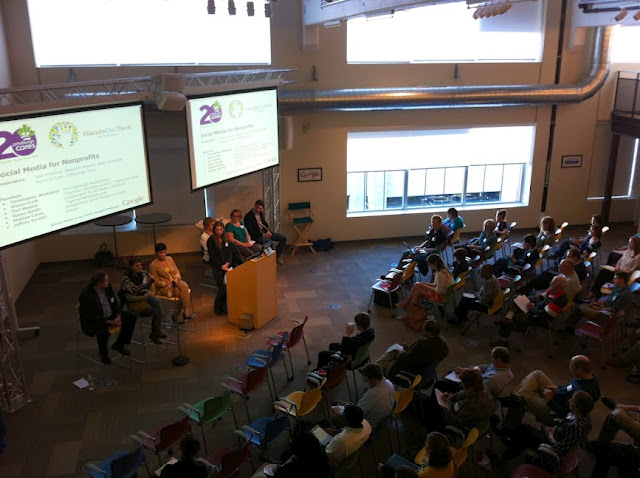
HandsOn Tech Pittsburgh hosted a panel on social media tools, including Google+, Twitter, Facebook and LinkedIn, with local nonprofits at the Google Pittsburgh office
The program has been so successful that we’re expanding—it will now include one additional city and 28 new VISTA positions, with the goal of reaching even more nonprofits. The new HandsOnTech VISTAs will start in August with a one week training at our campus in Mountain View, Calif., where they’ll learn about cloud-based tools from a variety of technology companies including the Google For Nonprofits suite that allows many nonprofits to use free online advertising, Google Apps and YouTube channels. Once they are armed with tech know-how they’ll spend the rest of the year in two and three-person teams serving nonprofits in the Bay Area, Atlanta, Boston, Chicago, Detroit, New York City, Pittsburgh and Seattle.
HandsOn Tech is accepting applications for VISTA members now through June 27. If you’re passionate about technology and helping nonprofits on the front line of fighting poverty, then we hope you’ll apply!
Rabu, 20 Juni 2012
The Endangered Languages Project: Supporting language preservation through technology and collaboration
The Miami-Illinois language was considered by some to be extinct. Once spoken by Native American communities throughout what’s now the American Midwest, its last fluent speakers died in the 1960s. Decades later, Daryl Baldwin, a citizen of the Miami Tribe of Oklahoma, began teaching himself the language from historical manuscripts and now works with the Miami University in Ohio to continue the work of revitalizing the language, publishing stories, audio files and other educational materials. Miami children are once again learning the language and—even more inspiring—teaching it to each other.
Daryl’s work is just one example of the efforts being made to preserve and strengthen languages that are on the brink of disappearing. Today we’re introducing something we hope will help: the Endangered Languages Project, a website for people to find and share the most up-to-date and comprehensive information about endangered languages. Documenting the 3,000+ languages that are on the verge of extinction (about half of all languages in the world) is an important step in preserving cultural diversity, honoring the knowledge of our elders and empowering our youth. Technology can strengthen these efforts by helping people create high-quality recordings of their elders (often the last speakers of a language), connecting diaspora communities through social media and facilitating language learning.
The Endangered Languages Project, backed by a new coalition, the Alliance for Linguistic Diversity, gives those interested in preserving languages a place to store and access research, share advice and build collaborations. People can share their knowledge and research directly through the site and help keep the content up-to-date. A diverse group of collaborators have already begun to contribute content ranging from 18th-century manuscripts to modern teaching tools like video and audio language samples and knowledge-sharing articles. Members of the Advisory Committee have also provided guidance, helping shape the site and ensure that it addresses the interests and needs of language communities.
Google has played a role in the development and launch of this project, but the long-term goal is for true experts in the field of language preservation to take the lead. As such, in a few months we’ll officially be handing over the reins to the First Peoples' Cultural Council (FPCC) and The Institute for Language Information and Technology (The LINGUIST List) at Eastern Michigan University. FPCC will take on the role of Advisory Committee Chair, leading outreach and strategy for the project. The LINGUIST List will become the Technical Lead. Both organizations will work in coordination with the Advisory Committee.
As part of this project, research about the world’s most threatened languages is being shared by the Catalogue of Endangered Languages (ELCat), led by teams at the University of Hawai’i at Manoa and Eastern Michigan University, with funding provided by the National Science Foundation. Work on ELCat has only just begun, and we’re sharing it through our site so that feedback from language communities and scholars can be incorporated to update our knowledge about the world’s most at-risk languages.
Building upon other efforts to preserve and promote culture online, Google.org has seeded this project’s development. We invite interested organizations to join the effort. By bridging independent efforts from around the world we hope to make an important advancement in confronting language endangerment. This project’s future will be decided by those inspired to join this collaborative effort for language preservation. We hope you’ll join us.
Langganan:
Postingan (Atom)