Tampilkan postingan dengan label green. Tampilkan semua postingan

Senin, 18 Juni 2012

The Surui Cultural Map

This week we're at Rio+20, the United Nations Conference on Sustainable Development. We're sharing a series of posts about our activities at the conference on the Green Blog; in this cross-post we've gone into more detail about one announcement taking place there. -Ed.

This week at the Rio+20 conference, the Surui tribe of the Brazilian Amazon are launching their Surui Cultural Map on Google Earth. This represents the culmination of a unique five-year collaboration between the Surui people and Google, which began in June 2007 when Chief Almir Surui first visited Google and proposed a partnership. The story of that visit, and the remarkable project that followed, are told in a new short documentary also launching here at Rio+20: “Trading Bows and Arrows for Laptops: Carbon and Culture.”


Training the Surui youth as mapmakers
Over three visits to the Surui territory between 2008 and last month, our Google Earth Outreach team taught Surui youth how to take photos and videos and to collect stories from their elders (such as from the time before first contact with the modern world). Then they learned how to upload these to the Google cloud using tools like Picasa, Docs, and YouTube. From there we used Spreadsheet Mapper 3 to bind it all together to create a Google Earth KML of their map, which contains almost 300 sites.

Map highlights
Through this project, my team has learned that maps are an expression of culture. Mapmakers refer to the “atomic element” of a map as a point of interest, or POI. The Surui mapmakers created POIs that reflect their traditional culture’s close interdependency with their forest home. So instead of hotels and gas stations, on the Surui map you’ll find the locations of parrots and toucans, or the three kinds of trees necessary to make their bows and arrows. You’ll learn where to find the Acai trees (which provide delicious fruit as well as the thatch for their maloca longhouses), the locations of good hunting grounds for the porcao (wild pig), and where the jaguar roam (jaguars have particular spiritual significance to the Surui people and figure in their creation myth). There are also sites and stories of historical battles with other tribes and with the white settlers who started arriving after “first contact” in 1969. Here’s an example POI for the Jenipapo tree:

The text reads: “Jenipapo fruit is produced by the jenipapo tree, which reaches twenty feet high. From the meaty part of the green fruit, an ink is extracted with which human skin can be painted. This makes the fruit very important for the Surui, because the art of painting is always included in everything that they do, especially in celebrations and rituals. The art of painting is one of the things most valued by Paiter. Each occasion calls for a different type of painting.”

Here’s a rich storytelling tour of the Surui Cultural Map, narrated by Chief Almir and the Surui youth who were the star mapmakers:


As Chief Almir says at the conclusion of the Surui people’s Google Earth tour:
Without the forest, our entire culture would disappear. And without our culture, the forest would have disappeared a long time ago. It’s important to live in a sustainable way and to strengthen those whose livelihoods directly depend on a healthy ecosystem. We have a 50-year sustainability plan, which includes solutions for our territory. An example is the Surui Carbon Project, which uses technology to monitor the carbon stock of forest and trade it in the market for carbon credits. Our hope is that we can come together virtually and in person, and that we can find and implement solutions together.
It’s been a great honor for us to work with the Surui people and to experience their world view, especially to see how they blend their traditional knowledge and culture with modern technology. We’ve learned from Chief Almir that partnerships, consensus and collaboration are central; in that spirit, we’d like to thank our partners on this project: ECAM, Kanindé and Brazilian filmmaker Denise Zmekhol, who has documented the life of the Surui people for more than twenty years.

You can watch a video of the  tour or download it in English or Portuguese. To learn more about the Surui tribe, known as “Paiter Surui,” please visit www.paiter.org.


(Cross-posted from the Green Blog)

Energy efficiency in the cloud

We’re obsessed with building energy efficient data centers that enable cloud computing. Besides helping you be more productive, cloud-based services like Google Apps can reduce energy use, lower carbon emissions and save you money in the process. Last year, we crunched the numbers and found that Gmail is up to 80 times more energy-efficient (PDF) than running traditional in-house email. We’ve sharpened our pencils again to see how Google Apps as a whole—documents, spreadsheets, email and other applications—stacks up against the standard model of locally hosted services. Our results show (PDF) that a typical organization can achieve energy savings of about 65-85 percent by migrating to Google Apps.

Lower energy use results in less carbon pollution and more energy saved for organizations. That’s what happened at the U.S. General Services Administration (GSA), which recently switched its approximately 17,000 users to Google Apps for Government. We found that the GSA was able to reduce server energy consumption by nearly 90 percent and carbon emissions by 85 percent. That means the GSA will save an estimated $285,000 annually on energy costs alone, a 93 percent cost reduction.

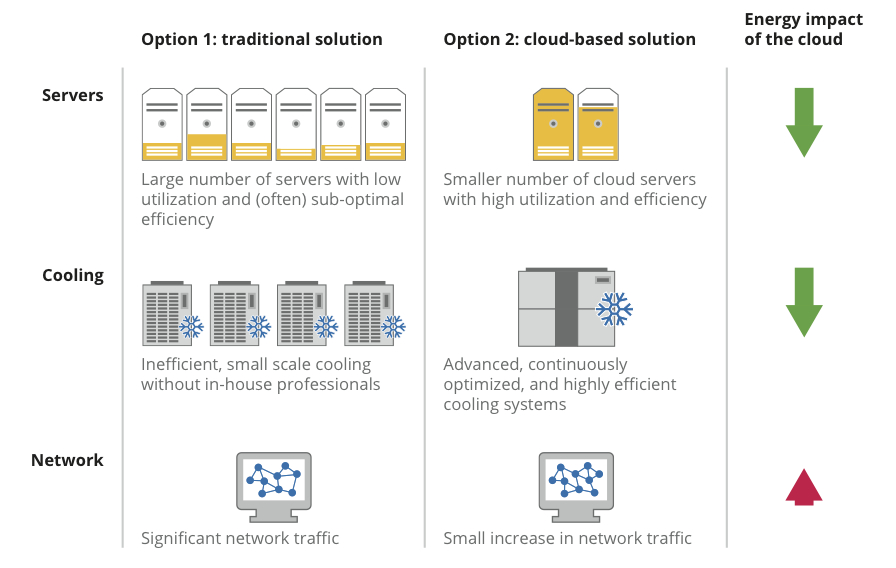
How is the cloud so energy efficient? It’s all about reducing energy use for servers and server cooling. Here’s how it works:


A typical organization has a lot more servers than it needs—for backup, failures and spikes in demand for computing. Cloud-based service providers like Google aggregate demand across thousands of people, substantially increasing how much servers are utilized. And our data centers use equipment and software specially designed to minimize energy use. The cloud can do the same work much more efficiently than locally hosted servers.

In fact, according to a study by the Carbon Disclosure Project, by migrating to the cloud, companies with over $1 billion in revenues in the U.S. and Europe could achieve substantial reductions in energy costs and carbon emissions by 2020:

  • U.S. companies could save $12.3 billion and up to 85.7 million metric tonnes of CO2
  • U.K. companies (PDF) would save £1.2 billion and more than 9.2 million metric tonnes of CO2
  • French companies (PDF) could save nearly €700 million and 1.2 million metric tonnes of CO2

We’ve built efficient data centers all over the world, even designing them in ways that make the best use of the natural environment, and we continue working to improve their performance. We think using the super-efficient cloud to deliver services like Google Apps can be part of the solution towards a more energy efficient future.

Posted by Urs Hoelzle, Senior Vice President for Technical Infrastructure

(Cross-posted on the Google Green Blog)

Selasa, 15 Mei 2012

Follow an email’s journey with Story of Send

If you’re anything like me, you send and receive a lot of emails every day. But have you ever wondered where your message goes after you hit “send?” How does an email travel from your computer to your friend’s smartphone across the country or around the world?

We’re answering those questions with Story of Send, a new site that gives you a behind-the-scenes look into how all that virtual information makes its journey through the real world—from your Internet service provider to our data centers and beyond. Along the way, you’ll discover everything from where we filter for spam and scan for viruses to how we’re minimizing our impact on the environment through energy efficiency and renewable power.


We’ve included videos and photos throughout the journey so you can explore certain areas more deeply. For example, if you’re curious what data center servers look like, we’ve included some photos. Or you can watch a video to learn about how we purchase clean energy from wind farms near our data centers. And because technology doesn’t always have to be serious, you might find a vampire or two lurking around or uncover other surprises on the journey.

In the past, Gmail fans have shown us how emails connect people across the world. Now we’re providing a glimpse into how those emails go from one place to another. So hit send and start the journey today.

Minggu, 22 April 2012

Planting some green this Earth Day

Cross-posted on the Lat Long and Google Green blogs

Since 1970, people all over the world have recognized April 22 as Earth Day, an opportunity to appreciate and generate awareness about the natural environment. Here at Google we strive to do our part to make sure our planet is healthy for years to come. From investing in renewable energy to building products that help people be greener in their own lives, we’re building a better web that’s better for the environment.

Today, we’re celebrating Earth Day in a variety of ways. The coming of spring inspired us to grow our annual Earth Day doodle right in our backyard. We planted seeds on a balcony at our Mountain View headquarters and watched them grow into what you see today. We’re also partnering with Friends of the Urban Forest to help make San Francisco schools a little greener.

To help you start a garden of your own, we’ve put together an Earth Day resource page. Explore community gardens and farmers’ markets on our interactive map, get discounted seeds to plant flowers, herbs and vegetables in your own backyard and connect with other gardeners for planting tips and inspiration.


We hope you find these resources useful and enjoy gardening as much as we do. On our Mountain View, Calif. campus, we have community gardens where Googlers can grow and harvest their choice of herbs and vegetables. Company-wide, we focus on getting organic, locally-grown produce for our cafes. We purchase food directly from farms near our campuses, and learn about how our suppliers raise, farm and harvest their food—all to ensure that we’re eating sustainably and being good to the environment.


We hope this Earth Day you are inspired to add a little green to the planet. Earth Day may only be a single day, but the actions we take can last for years to come.

Senin, 09 April 2012

One desk chair—hold the formaldehyde

Formaldehyde. Lead. Pesticides. Mercury. If building materials had nutrition labels, would you buy a product containing these toxic ingredients? There are more than 80,000 chemicals in the world, and we don’t fully know how they impact our health. And a surprising number of hazardous chemicals still make their way into everyday products we use, including furniture, paints, carpets and flooring. Whether it’s in the home or office, we shouldn’t have to worry that the chair we’re sitting in or the air we breathe contains harmful chemicals (PDF).

On my first day on the job at Google over six years ago, a co-worker asked me to sniff a carpet sample. I didn’t smell anything and was told, “That’s good!” We want to build a greener future and create the healthiest work environments imaginable for Googlers, which means we only use paints, sealants, adhesives, carpets, furniture and building materials with the lowest levels of VOCs (volatile organic compounds) possible.

A straw-hut style huddle room made with sustainably forested wood from Pescadero Willow Farm, bound by a saline-based, toxin-free solution

Unfortunately, the lack of clear and widely-available product ingredient information makes progress in this area challenging, so we’re asking the market to provide toxin-free products and make its contents an open book. We put all our products through a rigorous screening process to make sure they meet our healthy materials standards, and request full transparency from our vendors by asking them to share comprehensive product ingredient information.

This movement is also gaining momentum outside of Google. Recently, 30 leading building product manufacturers signed on to pilot the Health Product Declaration (HPD) Open Standard, the industry’s first common reporting standard for transparency around health impacts of building materials. Google is a founding endorser of the HPD, and we applaud these manufacturers for taking this important step. Continued leadership like this is needed for the product transparency revolution to gain real traction—not just for building materials but all types of products we consume or use.

So whether you’re at the restaurant or hardware store, ask tough questions so you can make better-informed choices about products to help keep yourself and your families healthy. Your collective voice and purchasing power can make a huge difference.

As for Google, by setting high standards, asking difficult questions and encouraging transparency from our partners, we hope to show how other organizations can create their own healthy and sustainable work environments.

Senin, 26 Maret 2012

Measuring to improve: comprehensive, real-world data center efficiency numbers

To paraphrase Lord Kelvin, if you don’t measure you can’t improve. Our data center operations team lives by this credo, and we take every opportunity to measure the performance of our facilities. In the same way that you might examine your electricity bill and then tweak the thermostat, we constantly track our energy consumption and use that data to make improvements to our infrastructure. As a result, our data centers use 50 percent less energy than the typical data center.

One of the measurements we track is PUE, or power usage effectiveness. PUE is a ratio of the total power used to run a data center to the amount used to power the servers. For instance, if a data center has a PUE of 2.0, that means that for every watt of energy that powers the servers, another watt powers the cooling, lighting and other systems. An ideal PUE would be 1.0.

In 2011, our trailing 12-month average PUE was approximately 1.14—an improvement from 1.16 in 2010. In other words, our data centers use only 14 percent additional power for all sources of overhead combined. To calculate this number we include everything that contributes to energy consumption in our data centers. That means that in addition to the electricity used to power the servers and cooling systems, we incorporate the oil and natural gas that heat our offices. We also account for system inefficiencies like transformer, cable and UPS losses and generator parasitic energy draw.

If we chose to use a simpler calculation—for instance, if we included only the data center and the cooling equipment—we could report a PUE as low as 1.06 at our most efficient location. But we want to be as comprehensive as possible in our measurements. You can see the difference in this graphic:


We’ve been publishing our PUE quarterly since 2008—in fact, we were the first company to do so, and are still the only one. Our numbers are based on actual production data taken from hundreds of meters installed throughout our data centers, not design specs or best-case scenarios. One way to think of it is comparing a car manufacturer’s mileage estimates for a new model car to the car’s real-life miles per gallon. We’re measuring real-world mileage so we can improve real-world efficiency.

Our 2011 numbers and more are available for closer examination on our data center site. We’ve learned a lot through building and operating our data centers, so we’ve also shared our best practices. These include steps like raising the temperature on the server floor and using the natural environment to cool the data center, whether it’s outside air or recycled water.

We’ve seen dramatic improvements in efficiency throughout the industry in recent years, but there’s still a lot we can do. Sharing comprehensive measurement data and ideas for improvement can help us all move forward.

Kamis, 15 Maret 2012

Helping the Hooch with water conservation at our Douglas County data center

If you’re familiar with the work of the Southern poet Sidney Lanier, you’ll know he wrote about the beauty of the Chattahoochee River in Georgia. “The Hooch,” as it’s known around here, starts up in the northeastern part of the state, runs through Atlanta and down into Alabama before emptying out into the Gulf of Mexico. Those of us who work in Google’s Douglas County, Ga. data center have a special fondness for the Chattahoochee because it’s an integral part of our ability to run a highly efficient facility.

Google’s data centers use half the energy of a typical data center in part because we rely on free cooling rather than energy hungry mechanical chillers. In Douglas County, like at most of our facilities, we use evaporative cooling, which brings cold water into the data center to cool the servers, then releases it as water vapor through cooling towers.

A typical data center can use hundreds of thousands of gallons of water a day. When we first built the Georgia facility in 2007, the water we used came from the local potable (drinking) water supply. But we soon realized that the water we used didn’t need to be clean enough to drink. So we talked to the Douglasville-Douglas County Water and Sewer Authority (known locally as the WSA) about setting up a system that uses reuse water—also known as grey- or recycled water—in our cooling infrastructure. With this system in place, we’re able to use recycled water for 100 percent of our cooling needs.

This video of the system includes never-before-seen footage of our Douglas County facility:


Here’s how it works: The WSA has a water treatment facility in Douglasville, Ga. that cleans wastewater from the local communities and releases it back into the Chattahoochee. We worked with the WSA to build a side-stream plant about five miles west of our data center that diverts up to 30 percent of the water that would have gone back into the river; instead we send it through the plant for treatment and then on to the data center. Any water that doesn’t evaporate during the cooling process then goes to an Effluent Treatment Plant located on-site. There, we treat the water once again to disinfect it, remove mineral solids and send it back out to the Chattahoochee—clean, clear and safe.


The Chattahoochee provides drinking water, public greenspace and recreational activities for millions of people. In fact, just two weeks ago it was the first river to be designated a National Water Trail in a new system announced by the Secretary of the Interior Ken Salazar—a system that encourages community stewardship of local waterways. We’re glad to do our part in creating an environmentally sustainable economy along the shores of the Hooch.

Kamis, 19 Januari 2012

Keeping our environmental management and workplace safety standards high

For the last year, our data center team has been working on a project to bring our facilities to even higher standards for environmental management and workforce safety. Recently we got the good news that our work paid off.

All of our U.S. owned and operated data centers have received ISO 14001 and OHSAS 18001 certification. We’re the first major Internet services company to gain external certification for those high standards at all of our U.S. data centers.


In a nutshell, both standards are built around a very simple concept: Say what you’re going to do, then do what you say—and then keep improving. The standards say what key elements are required, but not how to do it—that part’s up to us. So we set some challenging goals for ourselves, and we asked our auditors to confirm that we’ve followed through on them.

Here’s an example of the kind of improvements we’ve implemented: Like most data centers, ours have emergency backup generators on hand to keep things up and running in case of a power outage. To reduce the environmental impact of these generators, we’ve done two things: first, we minimized the amount of run time and need for maintenance of those generators. Second, we worked with the oil and generator manufacturers to extend the lifetime between oil changes. So far we’ve managed to reduce our oil consumption in those generators by 67 percent.

A second example: each of our servers in the data center has a battery on board to eliminate any interruptions to our power supply. To ensure the safety of the environment and our workers, we devised a system to make sure we handle, package, ship and recycle every single battery properly.

These are just two elements of what ultimately adds up to a comprehensive system of policies that our data center teams follow in their day-to-day operations. We do this because we want to be the gold standard in environmental and workforce safety, and because we care about the communities where we live and work. This is one more reason you can feel confident that when you're using our products, you're making an environmentally responsible choice.

Our data centers in the following U.S. locations have received this dual certification. We plan to pursue certification in our European data centers as well.
  • The Dalles, Ore.
  • Council Bluffs, Iowa
  • Mayes County, Okla.
  • Lenoir, N.C.
  • Monck’s Corner, S.C.
  • Douglas County, Ga.

Selasa, 20 Desember 2011

Ending the year with another clean energy investment

We’ve made a new $94 million investment in a portfolio of four solar photovoltaic (PV) projects being built by Recurrent Energy near Sacramento, California. This brings our portfolio of clean energy investments to more than $915 million. We’ve already committed to providing funding this year to help more than 10,000 homeowners install solar PV panels on their rooftops. But this investment represents our first investment in the U.S. in larger scale solar PV power plants that generate energy for the grid—instead of on individual rooftops. These projects have a total capacity of 88 MW, equivalent to the electricity consumed by more than 13,000 homes.

We’re investing alongside global investment firm KKR and Recurrent Energy, a leading solar developer. Google will provide a $94 million equity investment and SunTap Energy, a new venture formed today by KKR to invest in solar projects in the U.S., will provide the remaining equity.

We’re joining KKR on their first renewable energy investment in the U.S. We believe investing in the renewable energy sector makes business sense and hope clean energy projects continue to attract new sources of capital to help the world move towards a more sustainable energy future.

Solar panels at one of the Recurrent projects

The energy produced by these projects is already contracted for 20 years with the Sacramento Municipal Utility District (SMUD). SMUD recently created a feed-in tariff program (FIT) to help green the grid for Sacramento-area residents. We’re excited that these projects are the first to be built under the program.

We’ve had a busy year at Google. Since January, we’ve invested more than $880 million in clean energy projects. We believe the world needs a wide range of solutions—from wind, to transmission, to solar PV and concentrated solar—and we look forward to new opportunities next year to further expand our portfolio of clean energy investments.

Senin, 19 Desember 2011

Make your own online scrapbook with 2011 green search trends

Last week we unveiled this year’s Zeitgeist, including the fastest rising searches in 2011. Those of us on the Google Green team were pleased that the search trends include several popular searches related to the environment (as you can see from the highlights video). So we created the Green Scrapbook to help you explore these green trends, choose your favorites, and reveal videos and surprising facts about them. As you click around, you create your very own collection of what green meant to you this year, which you can personalize with your name and share with your friends.

People have already started creating and sharing their Green Scrapbook. For example, Adam created one showcasing a video of a tapir (Belize’s endangered “mountain cow”) and highlighting what an LED light is. I created my scrapbook, too, where I could tell people about the microorganisms that light up Puerto Rico’s famous “bioluminescent bay.” I also let people know that if I could win an eco-friendly car, I’d choose a Tesla (there’s still time to get me one for Christmas!).


Once you complete your own scrapbook, you can share it on Google+ or anywhere you’d like by grabbing the unique URL to your scrapbook with the “get URL” link at the top right.

We’re working hard to create a better web that’s also better for the environment. We hope the Green Scrapbook sparks conversation and gets people thinking about all the ways they can make greener choices in their lives—whether it’s about the merits of rooftop [solar energy], or prompting people to think about [garbage islands] and then reach for a [reusable water bottle].

Selasa, 27 September 2011

Taking in more sun with Clean Power Finance

(Cross-posted from the Green Blog)

This morning, at the Renewable Energy Finance Forum (REFF-West) in San Francisco, I announced a new $75 million investment to create an initial fund with Clean Power Finance that will help up to 3,000 homeowners go solar. This is our second investment in residential solar, and we’ve now invested more than $850 million overall to develop and deploy clean energy.

As we said when we made our first residential solar investment, we think it makes a lot of sense to use solar photovoltaic (PV) technology—rooftop solar panels—to generate electricity right where you need it at home. It greens our energy mix by using existing roof space while avoiding transmission constraints, and it can be cheaper than drawing electricity from the traditional grid.

Purchasing a solar system is a major home improvement, but the upfront cost has historically been one of the biggest barriers for homeowners. Solar installers across the country don’t always have the resources to find financing for customers, or the capital to provide it themselves. And for investors like Google, banks and others, it can be difficult to enter a fragmented solar market with many companies, and get connected to individual homeowners.

That’s where Clean Power Finance comes in. They’ve developed an open platform that connects installers with investors like Google to provide financing to homeowners. Solar installers sign up with Clean Power Finance to get access to the company’s comprehensive sales solutions, including consumer financing from investors, like the Google fund. This enables installers to sell more systems and grow their business. The installer builds the system, the investor (in this case, Google) owns it, and homeowners pay a monthly payment for the system, at a price that’s often less than paying for energy from the grid. Maintenance and performance are taken care of by Clean Power Finance and its network of installers.


Owned by Google, operated by Clean Power Finance and installed by American Vision Solar, the Colin family of Santa Clarita, Calif. has a 4.14 kW solar system

This innovative and scalable model makes business sense for Google, Clean Power Finance, solar installers and homeowners too. We’re excited to be one of the first investors to partner with Clean Power Finance and enable the company to continue forging strong relationships with solar installers (like the ones they announced last week with SunLogic, California Solar Systems, American Vision Solar—learn more on Clean Power Finance’s website). By making financing more readily available, the Clean Power Finance platform has the potential to lower costs and accelerate adoption of solar energy.

We’ve already installed a 1.6MW rooftop solar installation at the Googleplex back in 2007. Now, through Clean Power Finance and our previous investment this year, we’re hoping to have an even larger impact. We look forward to watching our funding help more than 10,000 homeowners generate clean electricity from the sun.

Kamis, 08 September 2011

How our cloud does more with less

We’ve worked hard to reduce the amount of energy our services use. In fact, to provide you with Google products for a month—not just search, but Google+, Gmail, YouTube and everything else we have to offer—our servers use less energy per user than a light left on for three hours. And, because we’ve been a carbon-neutral company since 2007, even that small amount of energy is offset completely, so the carbon footprint of your life on Google is zero.

We’ve learned a lot in the process of reducing our environmental impact, so we’ve added a new section called “The Big Picture” to our Google Green site with numbers on our annual energy use and carbon footprint.


We started the process of getting to zero by making sure our operations use as little energy as possible. For the last decade, energy use has been an obsession. We’ve designed and built some of the most efficient servers and data centers in the world—using half the electricity of a typical data center. Our newest facility in Hamina, Finland, opening this weekend, uses a unique seawater cooling system that requires very little electricity.

Whenever possible, we use renewable energy. We have a large solar panel installation at our Mountain View campus, and we’ve purchased the output of two wind farms to power our data centers. For the greenhouse gas emissions we can’t eliminate, we purchase high-quality carbon offsets.

But we’re not stopping there. By investing hundreds of millions of dollars in renewable energy projects and companies, we’re helping to create 1.7 GW of renewable power. That’s the same amount of energy used to power over 350,000 homes, and far more than what our operations consume.

Finally, our products can help people reduce their own carbon footprints. The study (PDF) we released yesterday on Gmail is just one example of how cloud-based services can be much more energy efficient than locally hosted services helping businesses cut their electricity bills.

Visit our Google Green site to find out more.

Rabu, 07 September 2011

Gmail: It’s cooler in the cloud

(Cross-posted on Gmail, Green and Enterprise blogs)

Cloud computing is secure, simple, keeps you productive and saves you money. But the cloud can also save energy. A recent report by the Carbon Disclosure Project (CDP) and Verdantix estimates that cloud computing has the potential to reduce global carbon emissions by millions of metric tons. And Jonathan Koomey, a consulting professor at Stanford who has led several studies on data center energy use, has written that for many enterprises, the cloud “is significantly more energy efficient than using in-house data centers.”

Because we’re committed to sustainability, we sharpened our pencils and looked at our own services to see how they stack up against the alternatives.

We compared Gmail to the traditional enterprise email solutions it’s replaced for more than 4 million businesses. The results were clear: switching to Gmail can be almost 80 times more energy efficient (PDF) than running in-house email. This is because cloud-based services are typically housed in highly efficient data centers that operate at higher server utilization rates and use hardware and software that’s built specifically for the services they provide—conditions that small businesses are rarely able to create on their own.

An illustration of inefficient server utilization by smaller companies compared to efficient utilization in the cloud.

If you’re more of a romantic than a businessperson, think of it this way: It takes more energy to send a message in a bottle than it does to use Gmail for a year, as long as you count (PDF) the energy used to make the bottle and the wine you drank.


We ran a similar calculation for YouTube and the results are even more striking: the servers needed to play one minute of YouTube consume about 0.0002 kWh of energy. To put that in perspective, it takes about eight seconds for the human body to burn off that same amount. You’d have to watch YouTube for three straight days for our servers to consume the amount of energy required to manufacture, package and ship a single DVD.


In calculating these numbers, we included the energy used by all the Google infrastructure supporting Gmail and YouTube. Of course, your own laptop or phone also consumes energy while you’re accessing Google, so it’s important to choose an efficient model.

There’s still a lot to learn about the global impacts of cloud computing, but one thing we can say with certainty: bit for bit, email for email, and video for video, it’s more efficient in the cloud.

Rabu, 31 Agustus 2011

Taking cars off the road with our transportation programs

This is the third in a short series of posts and videos spotlighting our efforts to make Google greener. In this post, we give you a glimpse at how our transportation programs help Googlers get to work while leaving their cars at home. -Ed.

Commuting to work without driving, meeting with someone on another continent without flying and riding cars without gasoline? It’s not a futuristic dream, but a way of life at Google. We support and encourage carbon-free commuting because it’s a vital part of our longstanding commitment to sustainability.

We help take cars off of the road—not quite like the Hulk, but we are green. Back in 2004, one motivated Googler started a vanpool that ran from San Francisco to Mountain View as a 20 percent project. As demand grew, the program morphed into what is now one of the largest corporate shuttle services in the country. Today, up to a third of employees ride the GBus shuttles throughout our Bay Area offices five days a week—that’s more than 3,500 daily riders, or 7,000 one-way car trips avoided each day.


Beyond the convenience and comfort that our shuttle rides offer—of which I’m reminded during my daily 35-mile commute from Alameda to Mountain View—they’re also environmentally friendly. Our shuttles have the cleanest diesel engines ever built and run on 5 percent bio-diesel, so they’re partly powered by renewable resources that help reduce our carbon footprint. In fact, we’re the first and largest company with a corporate transportation fleet using engines that meet the Environmental Protection Agency’s 2010 emission standards.

Not only do we encourage self-powered commuting, we reward it. Googlers earn credits each time they get to work via alternative (non-engine) means—by bike, foot, skateboard or kayak. These credits are then translated into a dollar amount that gets donated—$100 for every 20 days of participation—to the Googler’s charity of choice. This year, 56 offices also participated in “Bike to Work Day,” with more than 2,500 Googlers who biked to work worldwide. The annual celebration is meant to reward daily cyclists as well as introduce many new riders to biking.

The green life doesn’t stop once Googlers get to work. In Mountain View, our GBike system distributes about 1,000 bikes across the campus that Googlers can pick up whenever they have to get to another building. For longer distances and off-campus trips, we have the GFleet, our electric vehicle car share program, and our on-campus taxi service GRide. We're also installing hundreds of electric vehicle charging stations throughout several of our offices, making it easy for Googlers to charge up their own electric cars for free at work. If Googlers need to chat with their colleagues in other cities or continents they can use video conferencing technology, which cuts down on potential air travel.

In total, the combination of the GFleet and our shuttles result in net annual savings of more than 5,400 metric tons of CO2. That's like taking over 2,000 cars off the road every day, or avoiding 14 million vehicle miles every year. With the help of Googlers, we’ll continue powering the wheels of sustainable transit innovation.

Kamis, 25 Agustus 2011

Food for (green) thought

This is the second in a short series of posts and videos spotlighting our efforts to make Google greener. In this post, we give you a glimpse at our sustainable food programs. -Ed.

When it comes to eating sustainably, it’s about more than being organic, grass-fed or cage-free. Through our food program, we delight and support Googlers as well as uphold our company’s health and environmental values. And it’s a job we relish, because food is such a defining part of our unique culture. Our cafes and microkitchens help spark greater innovation and collaboration, allowing different teams to come together to share ideas, problem-solve or just get to know each other better over lunch or a mid-morning snack.

As part of Google’s Food Team, we serve roughly 50,000 healthy and delicious meals every day at nearly 100 cafes around the world—and strive to apply sustainable food principles to all the cafes we operate. We aim to source food that’s as local, seasonal and organic as possible. This helps us prevent artificial additives, pesticides and hormones from entering Google’s food supply—whether that means sourcing our eggs from cage-free chickens or using steroid- and antibiotic-free poultry. It’s fresher, and it tastes better!


Through Google’s Green Seafood Policy, we’ve established guidelines to help ensure that (whenever and wherever possible) we purchase species caught locally from independently managed fisheries that use environmentally responsible catch practices. At our Mountain View headquarters, where we benefit from our proximity to the ocean and local agriculture, we’ve been able to establish close relationships with several local, independent farmers and fishermen. We see firsthand how they raise and harvest their stock, and what sustainable catch methods they use. Much of our Mountain View produce (nearly half of which is organic) comes from farms in California, and our seafood comes from within 200 miles. Many of our campuses also have edible gardens that empower green-thumbed Googlers to grow herbs for their own cooking.

Because optimal eating habits extend beyond the walls of our offices, we’re committed to helping Googlers make the most informed choices possible as part of a healthy lifestyle. We want to not only become the healthiest workforce, but also make it easier for employees to take Google’s sustainable food values home to share with friends and family. Many of our offices in the U.S. offer Community Supported Agriculture (CSA) programs where Googlers can buy fresh, seasonal produce directly from local farms that’s delivered right to campus. In Mountain View, we also recently launched the Google Green Grocer program, where Googlers can order the same high-quality, sustainably sourced seafood, meat and eggs they already enjoy in our cafes, while supporting local community fisheries and farms.

We also pay very close attention to how we manage and reduce waste from our food program. Most employees use non-disposable dishware, and all of our grab-and-go containers are compostable. We have recycling and composting bins throughout many of our offices worldwide, and 20 percent of food waste from our cafes is recycled. In fact, organic food waste from our cafes in Europe, the Middle East and Africa is recycled to help produce bio-diesel or electricity. In some of our U.S. offices, any untouched, edible food is donated to local shelters, and the rest is put to use as compost.

Through our our cafes, microkitchens, edible gardens and community-supported food programs, we’re connecting Googlers to sustainable values on a daily basis. The more we care about what happens to the food on our plates and where it comes from, the more it can improve our health, our local economies and the environment.

Rabu, 17 Agustus 2011

Building a healthier, greener Google

(Cross-posted on the Green blog)

This is the first in a short series of posts and videos spotlighting our efforts to make Google greener. In this post, we give you a glimpse at our green buildings. -Ed.

When it comes to greening our office buildings, we apply the same focus that we use for any of our products: put the user first. We want to create the healthiest work environments possible where Googlers can thrive and innovate. From concept through design, construction and operations, we create buildings that function like living and breathing systems by optimizing access to nature, clean air and daylight.


Since I arrived at Google in 2006, I’ve been part of a team working to create life-sustaining buildings that support the health and productivity of Googlers. We avoid materials that contain volatile organic compounds (VOCs) and other known toxins that may harm human health, so Googlers don’t have to worry about the air they’re breathing or the toxicity of the furniture, carpet or other materials in their workspaces. We also use dual stage air filtration systems to eliminate particulates and remaining VOCs, which further improves indoor air quality.

Since building materials don’t have ingredient labels, we’re pushing the industry to adopt product transparency practices that will lead to real market transformation. In North America, we purchase materials free of the Living Building Challenge Red List Materials and EPA Chemicals of Concern, and through the Pharos Project we ask our suppliers to meet strict transparency requirements.

We also strive to shrink our environmental footprint by investing in the most efficient heating, cooling and lighting systems. Throughout many of our offices, we’ve performed energy and water audits and implemented conservation measures to develop best practices that are applied to our offices worldwide. To the extent possible, we seek out renewable sources for the energy that we do use. One of the earliest projects I worked on at Google involved installing the first solar panels on campus back in 2007. They have the capacity to produce 1.6 megawatts of clean, renewable electricity for us, which supplies about 30 percent of our peak energy use on the buildings they cover.

With a little healthy competition, we’ve gotten Google’s offices around the world involved in greening our operations. Our internal Sustainable Pursuit program allows teams to earn points based on their office’s green performance—whether it’s through green cleaning programs, water efficiency or innovative waste management strategies. We use Google Apps to help us track progress toward our goals—which meet or exceed the U.S. Green Building Council’s LEED standards—and share what we’ve learned among our global facilities teams.

We’re proud of our latest LEED Platinum achievement for the interior renovation of an office building at the Googleplex. While we have other LEED Platinum buildings in our portfolio, it’s a first for our headquarters and a first for the City of Mountain View. The interior renovation was designed by Boora Architects and built by XL Construction, using healthy building materials and practices. In fact, we now have more than 4.5 million square feet of building space around the world on deck to earn LEED Certification.

Looking ahead, our team will have many more opportunities to redefine how we green our buildings and workspaces. It’s a win for Googlers, our business and the environment.

Jumat, 29 Juli 2011

Gone fishin’—piloting community supported fisheries at Google

(Cross-posted on the Google Green Blog)

I've always loved the ocean—I was born in Shanghai, which means "upon the sea.” And as a chef, I'm always drawn to food that claims a spirit of place. After moving to California, near Half Moon Bay, I began visiting the docks to buy seafood, and got to know the fishermen.

Over time, it became evident to me that this part of our food supply is broken: many consumers purchase stale, unsustainably-raised fish from chain grocers. Meanwhile, fishermen often sell their diminishing catch to wholesalers at a very low profit, meaning their livelihoods are no longer sustained by their catch. There’s also the environmental factor to consider: Overfishing and illegal practices cause worldwide decline in ocean wildlife populations and wreak havoc on underwater habitats—not to mention the carbon footprint of transporting seafood far from its origin.

Google’s chefs have long been committed to sourcing food for our cafes as locally, seasonally and organically as possible. And in our Mountain View headquarters, many employees cook with the same ingredients at home thanks to on-site Community Supported Agriculture (CSA) programs. When I joined the team as an executive chef in Mountain View, I wanted to make a difference in our purchasing program for seafood. For the five years leading up to then, I wrote a column for the San Francisco Chronicle called “Seafood by the Season,” and I knew it could be done. In early 2010, we began a push to apply the most rigorous standards to our seafood-buying practices, and respond to the in-the-moment fluctuations of the catch from small, independent fishermen.

Things took off from there. My colleague Quentin Topping dreamed of providing the same high-quality seafood we serve in our cafes for Googlers to take home to their families. That idea became the Google Community Supported Fishery (CSF), which we launched in May 2011. In this program, Googlers sign up to purchase a weekly supply of local, sustainable seafood, supplied through a partnership with the Half Moon Bay (HMB) Fisherman’s Association.


The Google Culinary team on a visit with fishermen in Half Moon Bay, Calif.—Quentin and I are the second and third from the left, in black.

We tend to think on a massive scale at Google—whether it’s how to deliver instant search results around the globe or help thousands of small businesses get online—but when it comes to feeding our employees at work and at home, it really comes down to a local touch. Knowing where our seafood, meat and produce come from, as well as knowing how they’re raised, farmed or harvested, makes all the difference in the on-the-ground work of sustainability. We see many bright spots ahead for our Community Supported Agriculture and Fishery programs, such as expansion to other offices and adding a grass-fed beef and pasture-raised poultry program. It’s exciting to work someplace where we can think big and local.

We know of two CSFs in the Bay Area. The Half Moon Bay Fishermen’s Association supplies only Google at the moment, but will soon add public drop-off sites—keep posted by visiting Farmigo.com. The other is CSea out of Bodega Bay. If you live elsewhere, we hope you’ll consider stepping up to create one in your area.

And even if you don’t live near the ocean or have direct access to fresh-caught seafood, the choices you make about what fish to purchase or order in restaurants can make a real difference. You may want to consider following the guidelines that we used for our Google Green Seafood policy: Whenever possible, purchase species caught locally and in-season, by small, independent fisher-families, using environmentally-responsible methods. We think it’s important to be responsive to the fluctuations of catch too, and source from fisheries that enforce catch limits or are guided by ecosystem-based management programs. As for us, we’ll continue to research and source responsibly managed farmed seafood, and always keep transparency and Googler health at the center of our program.


Selasa, 28 Juni 2011

Examining the impact of clean energy innovation

At Google, we’re committed to using technology to solve one of the greatest challenges we face as a country: building a clean energy future. That’s why we’ve worked hard to be carbon neutral as a company, launched our renewable energy cheaper than coal initiative and have invested in several clean energy companies and projects around the world.

But what if we knew the value of innovation in clean energy technologies? How much could new technologies contribute to our economic growth, enhance our energy security or reduce greenhouse gas (GHG) emissions? Robust data can help us understand these important questions, and the role innovation in clean energy could play in addressing our future economic, security and climate challenges.

Through Google.org, our energy team set out to answer some of these questions. Using McKinsey’s Low Carbon Economics Tool (LCET), we assessed the long-term economic impacts for the U.S. assuming breakthroughs were made in several different clean energy technologies, like wind, geothermal and electric vehicles. McKinsey’s LCET is a neutral, analytic set of interlinked models that estimates the potential economic and technology implications of various policy and technology assumptions.

The analysis is based on a model and includes assumptions and conclusions that Google.org developed, so it isn’t a prediction of the future. We’ve decided to make the analysis and associated data available everywhere because we believe it could provide a new perspective on the economic value of public and private investment in energy innovation. Here are just some of the most compelling findings:
  • Energy innovation pays off big: We compared “business as usual” (BAU) to scenarios with breakthroughs in clean energy technologies. On top of those, we layered a series of possible clean energy policies (more details in the report). We found that by 2030, when compared to BAU, breakthroughs could help the U.S.:
    • Grow GDP by over $155 billion/year ($244 billion in our Clean Policy scenario)
    • Create over 1.1 million new full-time jobs/year (1.9 million with Clean Policy)
    • Reduce household energy costs by over $942/year ($995 with Clean Policy)
    • Reduce U.S. oil consumption by over 1.1 billion barrels/year
    • Reduce U.S. total carbon emissions by 13% in 2030 (21% with Clean Policy)
  • Speed matters and delay is costly: Our model found a mere five year delay (2010-2015) in accelerating technology innovation led to $2.3-3.2 trillion in unrealized GDP, an aggregate 1.2-1.4 million net unrealized jobs and 8-28 more gigatons of potential GHG emissions by 2050.
  • Policy and innovation can enhance each other: Combining clean energy policies with technological breakthroughs increased the economic, security and pollution benefits for either innovation or policy alone. Take GHG emissions: the model showed that combining policy and innovation led to 59% GHG reductions by 2050 (vs. 2005 levels), while maintaining economic growth.
This analysis assumed that breakthroughs in clean energy happened and that policies were put in place, and then tried to understand the impact. The data here allows us to imagine a world in which the U.S. captures the potential benefits of some clean energy technologies: economic growth, job generation and a reduction in harmful emissions. We haven’t developed the roadmap, and getting there will take the right mix of policies, sustained investment in technological innovation by public and private institutions and mobilization of the private sector’s entrepreneurial energies. We hope this analysis encourages further discussion and debate on these important issues.

Jumat, 24 Juni 2011

An update on Google Health and Google PowerMeter

In the coming months, we’re going to retire two products that didn’t catch on the way we would have hoped, but did serve as influential models: Google Health (retiring January 1, 2012; data available for download through January 1, 2013) and Google PowerMeter (retiring September 16, 2011). Both were based on the idea that with more and better information, people can make smarter choices, whether in regard to managing personal health and wellness, or saving money and conserving energy at home. While they didn't scale as we had hoped, we believe they did highlight the importance of access to information in areas where it’s traditionally been difficult.

We’re making this announcement well in advance to give you plenty of time to download the information you might have stored in either product or to transfer it to another service, and we’re making it easy for you to do it in a variety of formats. More on how that works below.

More broadly, we remain committed as always to helping people around the world access and use information pertinent to them. We’ll continue to pursue this goal and to encourage government and industry to do the same.

Google Health
When we launched Google Health, our goal was to create a service that would give people access to their personal health and wellness information. We wanted to translate our successful consumer-centered approach from other domains to healthcare and have a real impact on the day-to-day health experiences of millions of our users.

Now, with a few years of experience, we’ve observed that Google Health is not having the broad impact that we hoped it would. There has been adoption among certain groups of users like tech-savvy patients and their caregivers, and more recently fitness and wellness enthusiasts. But we haven’t found a way to translate that limited usage into widespread adoption in the daily health routines of millions of people. That’s why we’ve made the difficult decision to discontinue the Google Health service. We’ll continue to operate the Google Health site as usual through January 1, 2012, and we’ll provide an ongoing way for people to download their health data for an additional year beyond that, through January 1, 2013. Any data that remains in Google Health after that point will be permanently deleted.

If you’re a Google Health user, we’ve made it easy for you to retrieve your data from Google Health any time before January 1, 2013. Just go to the site to download your information in any of several formats: you can print and save it, or transfer it to other services that support industry-standard data formats. Available formats include:
  • Printable PDF including all the records in your Google Health profile
  • Industry-standard Continuity of Care Record (CCR) XML that can be imported into other personal health tools such as Microsoft® HealthVault™
  • Comma-separated value (CSV) files that can be imported into spreadsheets and database programs for ongoing tracking and graphing
  • HTML and XML versions of the original “data notices” sent to your Google Health profile by linked data providers
  • A unified ZIP archive that includes all files you’ve uploaded to your profile, plus all of the formats above
Over the coming weeks we’ll also be adding the ability to directly transfer your health data to other services that support the Direct Project protocol, an emerging open standard for efficient health data exchange. And while we’ll discontinue the Google Health service at the beginning of 2012, we’ll keep these download options available for one more year, through the start of 2013. This approach to download and transfer capability is part of Google’s strong commitment to data liberation principles: providing free and easy ways for users to maintain control of their data and move it out of Google’s services at any time.

In the end, while we weren’t able to create the impact we wanted with Google Health, we hope it has raised the visibility of the role of the empowered consumer in their own care. We continue to be strong believers in the role information plays in healthcare and in improving the way people manage their health, and we’re always working to improve our search quality for the millions of users who come to Google every day to get answers to their health and wellness queries.

Google PowerMeter
We first launched Google PowerMeter as a Google.org project to raise awareness about the importance of giving people access to data surrounding their energy usage. Studies show that having simple access to such information helps consumers reduce their energy use by up to 15%; of course, even broader access to this information could help reduce energy use worldwide.

Since our launch, there’s been more attention given to this notion of people easily accessing their energy data. The installation of smart meters and other home energy devices is picking up steam, and states like California and Texas are moving forward to finalize policies and programs in this area. Earlier this month, the White House announced a goal of giving all consumers access to their energy usage in computer-friendly formats as part of a national plan for modernizing the electricity grid.

We’re pleased that PowerMeter has helped demonstrate the importance of this access and created something of a model. However, our efforts have not scaled as quickly as we would like, so we are retiring the service. PowerMeter users will have access to the tool until September 16, 2011. We have made it easy for you to download your data: simply log in to your account and go to "Account Settings” to export to a CSV (Comma Separated Values) file. We will be contacting users directly with more information on this process.

Momentum is building toward making energy information more readily accessible, and it’s exciting to see others drive innovation and pursue opportunities in this important new market. We’re proud of what we’ve accomplished with PowerMeter and look forward to what will develop next in this space.

By helping people make more informed decisions through greater access to more information, we believe Google Health and PowerMeter have been trailblazers in their respective categories. Ultimately though, we want to satisfy the most pressing needs for the greatest number of people. In the case of these two products, our inability to scale has led us to focus our priorities elsewhere.

As always, we welcome your feedback; please share your thoughts and opinions with us at health-feedback@google.com or powermeter-feedback@google.com. We won’t be able to respond to every email, but we promise we’ll listen.

Update 7/15/11: We've now added the ability to directly transfer your health data out of Google Health via the Direct Project protocol.

Selasa, 14 Juni 2011

Helping homeowners harness the sun

(Cross-posted from the Green Blog)

Imagine sitting on your patio watching the sun’s rays pass overhead, knowing that they power your home with clean energy—at a cost that’s less that what you would have paid using just the grid. That’s what my colleague, engineer Michael Flaster, has been doing at his home in Menlo Park, Calif. since March of this year. He did it with the help of a company called SolarCity, which enables homeowners and businesses to begin using solar energy to power their homes and buildings.

Today, we’re announcing that we’ve investing $280 million to create a fund that will help SolarCity finance more solar installations across the country. This is our largest clean energy project investment to date and brings our total invested in the clean energy sector to more than $680 million. We’ve also launched a partnership to offer SolarCity services to Googlers at a discount.


In SolarCity’s innovative financing model, the company covers installation and maintenance of the system over the life of the lease. You can prepay, or pay nothing upfront after which you make monthly solar lease payments. All told, Michael will save $100 per month on his energy bills this year, and more than $16,000 over his 15 year lease, after factoring in his lease payment and lower energy bills.


We believe the world needs a wide range of clean energy options in the future, each serving different needs. We’ve already invested in several large-scale renewable energy projects, so we’re excited that this new partnership with SolarCity helps people power their homes directly with solar energy, too. We think “distributed” renewable energy (generated and used right at home) is a smart way to use solar photovoltaic (PV) technology to improve our power system since it helps avoid or alleviate distribution constraints on the traditional electricity grid.

Our investment is a quadruple-win for Google, SolarCity, its new customers and the environment. We continue to look for other renewable energy investments that make business sense and help develop and deploy cleaner sources of energy. Whether harnessing the sun on rooftops like Michael’s or in the desert sands of the Mojave, it’s all part of building a clean energy future.