Selasa, 07 Februari 2012

Introducing Chrome for Android

In 2008, we launched Google Chrome to help make the web better. We’re excited that millions of people around the world use Chrome as their primary browser and we want to keep improving that experience. Today, we're introducing Chrome for Android Beta, which brings many of the things you’ve come to love about Chrome to your Android 4.0 Ice Cream Sandwich phone or tablet. Like the desktop version, Chrome for Android Beta is focused on speed and simplicity, but it also features seamless sign-in and sync so you can take your personalized web browsing experience with you wherever you go, across devices.


Speed
With Chrome for Android, you can search, navigate and browse fast—Chrome fast. You can scroll through web pages as quickly as you can flick your finger. When searching, your top search results are loaded in the background as you type so pages appear instantly. And of course, both search and navigation can all be done quickly from the Chrome omnibox.

Simplicity
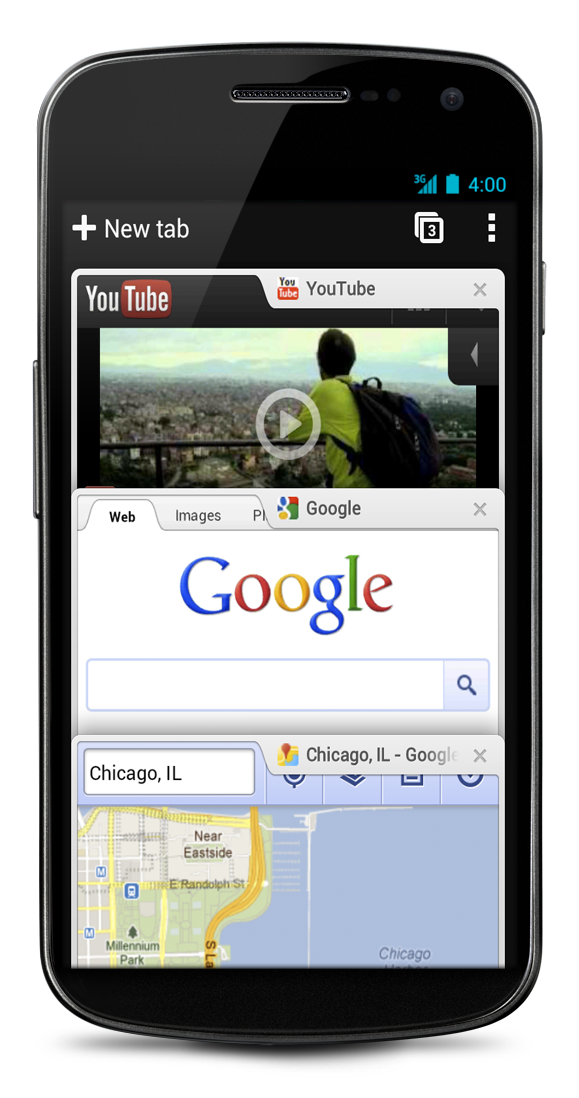
Chrome for Android is designed from the ground up for mobile devices. We reimagined tabs so they fit just as naturally on a small-screen phone as they do on a larger screen tablet. You can flip or swipe between an unlimited number of tabs using intuitive gestures, as if you’re holding a deck of cards in the palm of your hands, each one a new window to the web.

One of the biggest pains of mobile browsing is selecting the correct link out of several on a small-screen device. Link Preview does away with hunting and pecking for links on a web page by automatically zooming in on links to make selecting the precise one easier.

And as with Chrome on desktop, we built Chrome for Android with privacy in mind from the beginning, including incognito mode for private browsing and fine-grained privacy options (tap menu icon, ‘Settings,’ and then ‘Privacy’).

Sign in
You can now bring your personalized Chrome experience with you to your Android phone or tablet. If you sign in to Chrome on your Android device, you can:
  • View open tabs: Access the tabs you left open on your computer (also signed into Chrome)—picking up exactly where you left off.
  • Get smarter suggestions: If you visit a site often on your computer, you'll also get an autocomplete suggestion for it on your mobile device, so you can spend less time typing.
  • Sync bookmarks: Conveniently access your favorite sites no matter where you are or which device you’re using.


Chrome is now available in Beta from Android Market, in select countries and languages for phones and tablets with Android 4.0, Ice Cream Sandwich. We’re eager to hear your feedback. Finally, we look forward to working closely with the developer community to create a better web on a platform that defines mobile.


(Cross-posted from the Chrome blog and on the Mobile blog)

Senin, 06 Februari 2012

What’s your X? Amplifying technology moonshots

Last week, we ran an experiment. We hosted a gathering, called “Solve for X,” for experienced entrepreneurs, innovators and scientists from around the world. The event focused on proposing and discussing technological solutions to some of the world’s greatest problems. Discussions began last week with this small event, and now we invite others to join the conversation on our website and our Google +page.

The Solve for X gathering, which we co-hosted with Eric Schmidt, is a place to celebrate a concept we champion internally and that we believe will inspire many others: technology moonshots. These are efforts that take on global-scale problems, define radical solutions to those problems, and involve some form of breakthrough technology that could actually make them happen. Moonshots live in the gray area between audacious projects and pure science fiction; they are 10x improvement, not 10%. That’s partly what makes them so exciting.


Moonshots can come from anywhere—people of all ages and places, companies, academia, inspired experts, enthusiastic newcomers, and often from accidental discoveries. Take this Solve for X talk by Adrien Treuille, a professor of computer science and robotics at Carnegie Mellon University. He proposes that going forward significant science and technological advances will come from individual contributors—independent of their official affiliations or training. It sounds implausible, but he makes the case by discussing EteRNA and Foldit, scientific discovery games where individual gamers are lapping the best computer programs in DNA folding and RNA nano-fabrication problems. Rob McGinnis, co-founder of Oasys, suggests in his Solve for X talk that fresh water could be produced everywhere in the world at less than one-tenth the energy input or cost to the environment of what’s possible today. It sounds too good to be true because the world needs fresh water so very desperately, yet Rob is exploring dramatic technological breakthroughs in desalination to make this moonshot into a possible reality.

You can watch these videos and others on our site now, and we will add more in the coming week. Just wait to hear Mary Lou Jepsen’s Solve for X talk on how it may literally be possible to take pictures of the mind’s eye! The potential impact of this technology on the way we communicate, preserve memories and understand ourselves is staggering. Or consider Daphne Preuss, a leading geneticist who moved from academia to pursue plant genetics in order to help make the planet healthier and find ways to feed more people. She doesn’t plan to take on her moonshot herself, but she has a strong vision for what it would take to get it done and why it’s so important.

Our gathering last week brought together a group that is already practiced at moonshot thinking to propose specific solutions. At least a few times a year, we hope that people will take a few hours or a day or two out of their busy schedules to dare to push the boundaries, and to consider moonshot approaches to some of the world’s many unresolved challenges. Solve for X isn’t about developing a new business line or building an investment portfolio. Rather, it aims to be a forum where technology-based moonshot thinking is practiced, celebrated and amplified. We invite you to come collaborate with us at www.wesolveforx.com.

Supporting U.S. student veterans with a new scholarship

The newest addition to the Google scholarships family is the Google Student Veterans of America (SVA) Scholarship. We’re partnering with the nonprofit Student Veterans of America (SVA) to support their mission of providing veterans with the resources, support and advocacy they need to succeed in higher education and throughout their careers. The Google SVA Scholarship is available to student veterans who are pursuing degrees in computer science and related fields in the U.S. for the 2012-2013 academic year. In addition to the financial award, recipients will be invited to attend the annual all-expenses-paid scholars’ retreat at the Googleplex in Mountain View, Calif. in the summer of 2012.

We have a long history of helping university students pursue computer science education with scholarship and internship opportunities. Since our first scholarships were awarded in 2004, we’ve provided over $8.8 million dollars of financial support to 2,100 students from historically underrepresented groups worldwide. Our academic scholarship programs are just one part of our global effort to increase the diversity of the technology industry and invest in the next generation of computer scientists. This mission includes ensuring that student veterans in the U.S. have the support they need to pursue technology education and careers.

Google’s commitment to military veterans extends beyond our educational outreach efforts. The Google Veterans Network, one of our 18 employee groups dedicated to supporting diversity and inclusion at Google, fosters a community of support for our military veterans, reservists, guardsmen, family members and friends. In 2011, we introduced a customized job search engine called the Veterans Job Bank in partnership with the Department of Veterans Affairs. Members of our veterans’ community also partnered with the Google Creative Lab to launch Chrome for Wounded, Ill and Injured Warriors and to create Google for Veterans and Families, a new online resource that brings together our free products and platforms for service members and their families. As a Google engineer and a Marine veteran, I’m proud of our commitment to diversity and of our efforts to bring other veterans into the world of technology and computer science.

The deadline to apply for the Google SVA Scholarship is March 15, 2012.

For complete scholarship details, visit our scholarship programs page.


(Cross-posted from the Google Student blog)

Super Bowl XLVI: Mobile, Manning and Madonna

Now that the final Super Bowl touchdown has been scored, the dip bowl wiped clean and the last of the chicken wings devoured, we’re taking a look at some game-day search trends to see what football fans were searching for this year.

As the Giants and Patriots battled it out on the field yesterday, U.S. viewers multi-tasked, watching the game on television and also going online more than ever before, turning to their smartphones and tablets to look up players, halftime show performers and their favorite Super Bowl commercials. In fact, around 41% of searches related to [Super Bowl ads] that were made during the game came from mobile devices, up from 25% for the same time the day prior.

Overall, the top trending searches on Google during the game were:
  1. Madonna
  2. Halftime show
  3. Patriots
  4. Tom Brady
  5. Giants
This was the first year that the Super Bowl was live streamed, and there was a significant spike in searches related to Super Bowl live streaming on game day. Searches peaked at kickoff, and were made predominantly on desktop, followed by mobile phones and then tablets. Searches for the Spanish language version of the live stream made the list of top trending queries, and while it may have been after midnight on the other side of the Atlantic, we still saw searches for [Super Bowl 2012 übertragung] and [w9 streaming] in Germany and France, respectively.


The Giants claimed the game in a down-to-the-wire nail biter; however, the Patriots edged them out in searches. Patriots quarterback Tom Brady not only broke Joe Montana’s record for the most consecutive completions at a Super Bowl, he also scored the most searches out of all the players. Eli Manning, Victor Cruz, Aaron Hernandez and Danny Woodhead rounded out the top five players trending during the game.


The Material Girl Madonna took the honor of being the most-searched for term during the game, but other celebrities that caught viewers’ eyes included Super Bowl performers LMFAO, Kelly Clarkson and Nicki Minaj. Searches for Katherine McPhee’s soon-to-premiere NBC show [Smash] beat out searches for David Beckham’s H&M ad campaign.


Finally, no Super Bowl wrap-up would be complete without talking about the commercials. 2012 saw a pre-Super Bowl ad bonanza, with many of the top commercials either being teased or posted in full well in advance of the game. Super Bowl ads or ad teasers were watched more than 30 million times on YouTube before the big weekend this year (you can read more on the top rising Super Bowl searches on YouTube here).

Game day searches for [super bowl ads] were 122 times higher than the same time last week. The most popular commercials in terms of Google searches were ads from Acura, GoDaddy and M&M’s. Searches for The Avengers movie trailer were also trending, along with Chrysler’s spot featuring Clint Eastwood.

Now that you’ve seen them all, vote for your favorite commercial of the game on the YouTube Ad Blitz channel. The winning ads will be showcased on the YouTube homepage on February 18.

To download the full infographic above, visit Think Insights, our website for marketers. Our final Ad Blitz infographic (coming soon) will include new facts and stats about Super Bowl ads, and you can follow Think with Google on Google+ to be the first to know when it's released.

That’s it for the NFL 2012 season, but luckily, major league baseball is just around the corner...


Update 10:09am: Earlier, this post incorrectly stated that Patriots quarterback Tom Brady broke Joe Montana’s record for the most touchdown passes at a Super Bowl, instead of most consecutive completions. This post has been updated to correct the error.

Jumat, 03 Februari 2012

Unicode over 60 percent of the web

Computers store every piece of text using a “character encoding,” which gives a number to each character. For example, the byte 61 stands for ‘a’ and 62 stands for ‘b’ in the ASCII encoding, which was launched in 1963. Before the web, computer systems were siloed, and there were hundreds of different encodings. Depending on the encoding, C1 could mean any of ¡, Ё, Ą, Ħ, ‘, ”, or parts of thousands of characters, from æ to 品. If you brought a file from one computer to another, it could come out as gobbledygook.

Unicode was invented to solve that problem: to encode all human languages, from Chinese (中文) to Russian (русский) to Arabic (العربية), and even emoji symbols like or
; it encodes nearly 75,000 Chinese ideographs alone. In the ASCII encoding, there wasn’t even enough room for all the English punctuation (like curly quotes), while Unicode has room for over a million characters. Unicode was first published in 1991, coincidentally the year the World Wide Web debuted—little did anyone realize at the time they would be so important for each other. Today, people can easily share documents on the web, no matter what their language.

Every January, we look at the percentage of the webpages in our index that are in different encodings. Here’s what our data looks like with the latest figures*:

*Your mileage may vary: these figures may vary somewhat from what other search engines find. The graph lumps together encodings by script. We detect the encoding for each webpage; the ASCII pages just contain ASCII characters, for example. Thanks again to Erik van der Poel for collecting the data.

As you can see, Unicode has experienced an 800 percent increase in “market share” since 2006. Note that we separate out ASCII (~16 percent) since it is a subset of most other encodings. When you include ASCII, nearly 80 percent of web documents are in Unicode (UTF-8). The more documents that are in Unicode, the less likely you will see mangled characters (what Japanese call mojibake) when you’re surfing the web.

We’ve long used Unicode as the internal format for all the text Google searches and process: any other encoding is first converted to Unicode. Version 6.1 just released with over 110,000 characters; soon we’ll be updating to that version and to Unicode’s locale data from CLDR 21 (both via ICU). The continued rise in use of Unicode makes it even easier to do the processing for the many languages that we cover. Without it, our unified index it would be nearly impossible—it’d be a bit like not being able to convert between the hundreds of currencies in the world; commerce would be, well, difficult. Thanks to Unicode, Google is able to help people find information in almost any language.

Kamis, 02 Februari 2012

Mind the Gap: Encouraging women to study engineering

Women make up more than half the global population, but hold fewer than a third of the world’s engineering jobs. In the U.S., female students comprise fewer than 15 percent of all Advanced Placement computer science test takers. Even in high-tech Israel, few girls choose computer science. Not only is this a loss to companies like Google and everyone who benefits from a continually developing web; it's also a lost opportunity for girls.

Beginning in 2008, a group of female engineers at Google in Israel decided to tackle this problem. We established the “Mind the Gap!” program, aimed at encouraging girls to pursue math, science and technology education. In collaboration with the Israeli National Center for Computer Science Teachers, we began organizing monthly school visits for different groups of girls to the Google office and annual tech conferences at local universities and institutes. The girls learn about computer science and technology and get excited about its applications, as well as have a chance to talk with female engineers in an informal setting and see what the working environment is like for them.


Since we started this program over three years ago, we’ve hosted more than 1,100 teenage girls at our office, and an additional 1,400 girls at three annual conferences held in leading universities. These 2,500 students represent 100 schools from all sectors and from all over the country: Tel Aviv, Haifa, Tira, Beer-Sheva, Jerusalem, Nazareth and more; what they have in common is the potential to become great computer scientists.

The results are encouraging. For instance, some 40 percent of the girls who participated in last year’s conference later chose computer science as a high school major.

We encourage people in other countries, at other companies and in other scientific disciplines to see how they could replicate this program. You can read more at the project site. Currently, we are working with the Google in Education group to expand the program to more offices globally and get even more young women excited about computer science. The difference we can make is real: At one of our first visits three years ago, we met a 10th grade student named Keren who enjoyed math but had never considered computer science as a high school major. Last month, Keren informed us that the visit made such an impact on her, she decided to change her major to computer science. “Talking to women in the field helped me change my mind,” she said.

Rabu, 01 Februari 2012

Playbook for tackling the Super Bowl with Google

While thousands of lucky fans will brave the crowds at the Lucas Oil Stadium in Indianapolis, Ind. to fill the coveted seats at this Sunday’s Super Bowl, many more in the U.S. will enjoy the game from home—in front of the TV, with mobile phones and tablets at the ready.

As the New York Giants and New England Patriots prepare for kickoff, here are several ways to make the most of the big game with Google—wherever you’re watching. You can explore the full list in our Game Day with Google playbook, a new page on Inside Search that we’ve filled with tips on how to use Google to enjoy the game.

Get the inside scoop
Visit the Giants and Patriots Google+ pages for behind-the-scenes coverage and details on a chance for you to join the Giants pre-game hangout on Thursday for a face-to-face chat with the players. Be sure to leave a comment on their post for a chance to participate.


On Monday, Feb 6 at noon ET, stop by the NBC Sports Google+ page for a Hangout On Air with CNBC sports business reporter Darren Rovell. He’ll chat about the previous day’s game and review the best commercials with fans that drop in. Leave a comment on this NBC Sports post to throw your name in the hat to be one of the lucky participants who will chat with Rovell On Air.


Plan your party
Super Bowl party rivalry is already in full swing with Indiana leading the pack in Google searches for [super bowl party], ahead of both New York and Massachusetts. Despite New York being the home state of the buffalo wing, searches for [chicken wings] are nearly 50 percent higher in Massachusetts.

If you’re looking for a dip recipes, [hummus] reigns supreme, followed by guacamole, queso and bean dip. Use Google Recipe search to find a recipe with the ingredients to make everyone happy. Or, swing by ChefHangout on Google+ to join a cooking class on favorite Super Bowl party foods.

Talking babies or barking dogs? You decide.
It wouldn’t be the Super Bowl without the commercials. We’ve already seen a flurry of pre-game teasers pop up on YouTube and Google+, but which commercial will reign supreme? Our fifth annual YouTube Ad Blitz in partnership with NBC Sports enables you to replay and vote on your favorite commercials online from a laptop, mobile phone or tablet. Tune in to the YouTube Ad Blitz channel or NBCSports.com to watch and rate the commercials.


Watch the Madonna premiere on YouTube
If the halftime show interests you more than counting yards gained and lost, get an early taste of the show with Madonna’s music video premiere for “Give Me All Your Luvin” featuring Nicki Minaj and M.I.A on her official youtube.com/Madonna channel this Friday and on the YouTube Ad Blitz channel pre-game on Sunday. You can pre-order her deluxe album right there in the video description. And make sure to tune in to Madonna’s Google+ profile all week long for her latest news.

May the best team win!